
Don’t Use AI to Generate Images for Your Ads If You Are Not a Designer
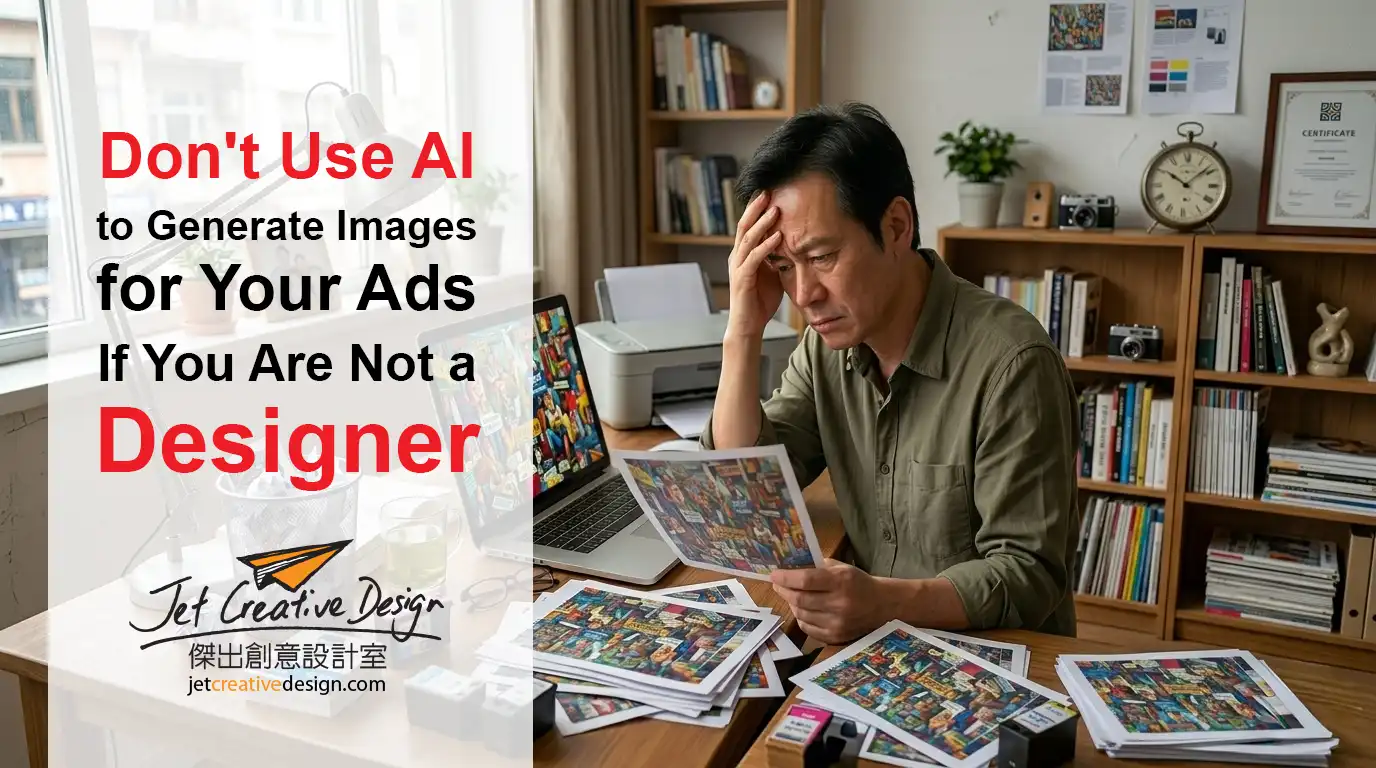
Artificial Intelligence (AI) has completely changed how we create content. With a simple text prompt, tools can generate stunning, complex visuals in seconds. For business owners looking to save time and trim marketing budgets, it is incredibly tempting to bypass professional design services and use raw AI-generated images for ads.
Recently, AI advancements have given us a lot of convenience to generate visuals and ads. With just a few clicks, you can instantly see a concept come to life, brainstorm layouts, or produce mockups without waiting days for initial drafts. It feels like the ultimate shortcut for modern marketing.
But… there is a massive gap between a visual that looks good on a screen and a file that actually works in production.
While AI is a powerful tool for ideation, it completely lacks the technical precision, spatial logic, and execution required for successful, real-world marketing. Relying solely on raw AI outputs for your commercial campaigns—especially print media—can do more harm to your brand’s credibility than good.
Here are 7 critical reasons why you shouldn’t use AI to generate images for your ads if you aren’t a designer:
1. Image Quality is Simply Not Suitable for Printing
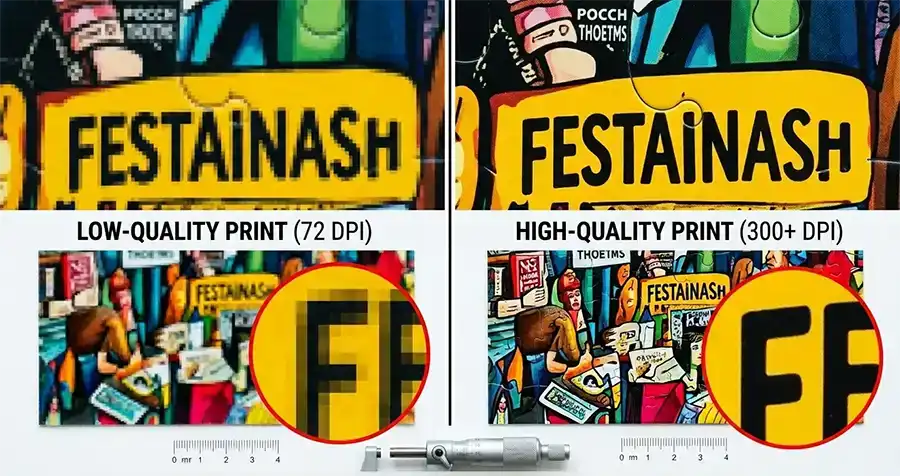
What looks stunning on a 6-inch smartphone screen often falls apart when scaled up for real-world media. AI image generators typically output files at low resolutions (usually 72 DPI), optimized strictly for web viewing.
For high-quality print advertising, images require a minimum of 300 DPI (Dots Per Inch). If you try to stretch a low-res AI file onto a banner, backdrop, or poster, it will turn out pixelated, blurry, and cheap. Furthermore, AI outputs flat pixel layers (raster images); they cannot inherently generate vector graphics, which are essential for logos and scalable typography.
2. “Too Much Info” Leads to No Info
AI has a tendency to over-complicate visuals, filling spaces with random artifacts and chaotic details.
In advertising, clarity is king. A successful ad relies on a clear visual hierarchy that guides the viewer’s eye straight to the focal point and the call to action (CTA). When there is too much random visual noise packed into a single image, your core message gets lost. If an ad tries to say everything at once, it ultimately communicates nothing.
3. Tiny, Unreadable Text and Bad Font Sizes
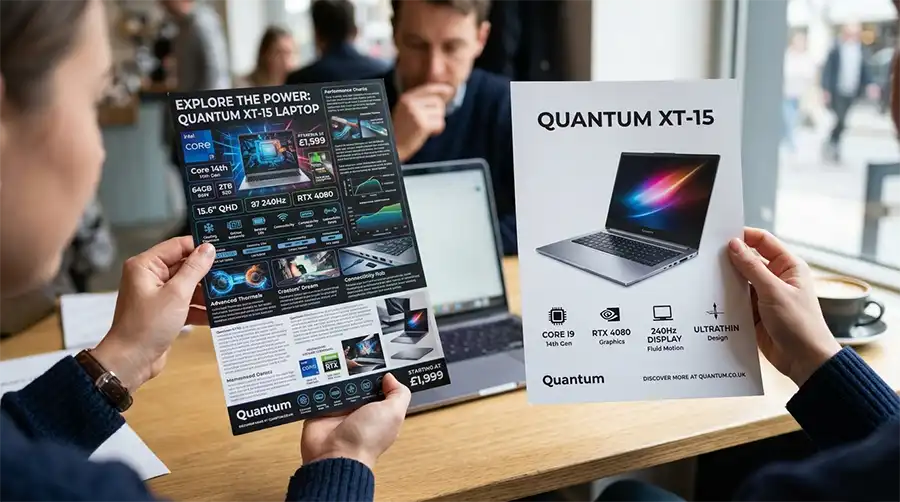
AI generators notoriously struggle with spelling and typography layout. Even if you manage to generate a clean visual, any embedded text is often distorted or completely unreadable.
If you are designing for print, legibility is everything. Professional designers know that printing readable fonts requires a size of at least 10 pt and above, depending on the typeface structure. AI does not understand these physical reading constraints, resulting in microscopic or warped text that your target audience will simply ignore.
4. Zero Ability to Modify, Layer, or Adjust Specific Assets
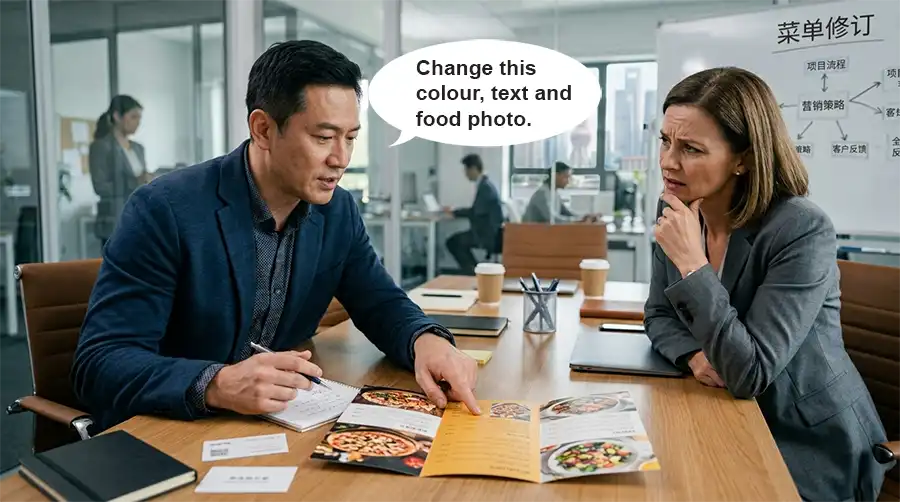
Imagine this scenario: You generate a near-perfect AI image for your ad, but the product in the character’s hand is the wrong color, or a background element contradicts your brand identity.
Because AI generates a flat, single-layer file (like a JPEG), you cannot easily modify individual elements. You can’t just “move an object to the left,” “isolate the background,” or “change one specific color shade” without advanced editing software like Adobe Photoshop or Illustrator. Without design skills, a tiny error means you have to throw the entire image away.
5. It is Completely Uncontrollable and Kills Brand Consistency
Consistency builds trust. When you work with a professional design agency, your brand assets are strictly mapped across multiple platforms to maintain the same identity.
With AI, you never truly know what the next generated visual will look like. It is largely unpredictable. Trying to create a cohesive multi-page catalog, a consistent brochure, or a unified social media ad carousel using raw AI prompts is nearly impossible. The lighting, character features, and underlying art styles will shift with every click, making your business look uncoordinated and fragmented.
6. The Screen-to-Print Color Disconnect (RGB vs. CMYK)
Have you ever printed a digital document and noticed the colors looked dull compared to your bright monitor? That is because digital screens display colors using the RGB spectrum (light), while physical printers use CMYK (ink).
AI generators operate entirely in the digital RGB workspace. Without a designer’s expertise to manually convert the color profiles, adjust color curves, and proof the artwork for professional CMYK printing, your final printed ads will likely look muddy, dark, or drastically different from what you saw on your screen.
7. No Concept of Bleed, Margins, and Safe Visual Areas
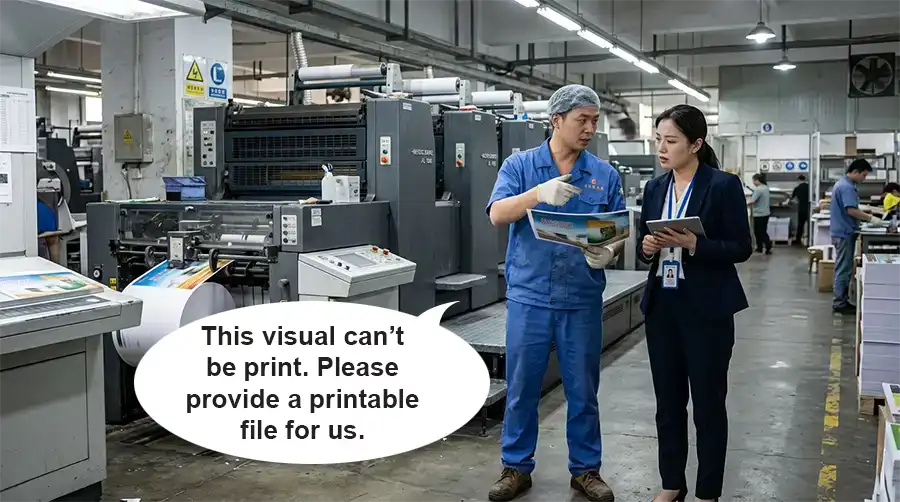
In the print production industry, exact measurements are non-negotiable. To prevent ugly white borders when a heavy industrial machine cuts a printed page, files must include a bleed area (extra background space extending past the final cutting line). Important text and brand logos must also stay strictly within a safe visual area so they don’t get accidentally sliced off.
AI tools have absolutely no concept of grid systems, structural margins, bleeds, or safe zones. Throwing a raw AI image straight into a print layout means risking your headlines or logos being cut in half during production.
The Verdict: AI is a Tool, Not the Designer
AI is fantastic for brainstorming, mood-boarding, and gathering creative inspiration. But it cannot replace the technical eye, strategic positioning, and production knowledge of a human designer.
Your advertisements represent your business’s credibility and authority in the market. Investing in professional graphic design ensures that your visuals are high-resolution, perfectly aligned with your brand identity, legally compliant, and technically flawless for both digital screens and physical print.
Want to ensure your next advertising campaign looks flawless, professional, and actually converts? Let our team handle the technicalities.
Contact Jet Creative Design today to bring your vision to life the right way!
https://jetcreativedesign.com/contact/